
Concrete vs. Pavers for a Houston Driveway: Honest Comparison
When does poured concrete win, and when do pavers win? A side-by-side comparison built for Texas clay soil.
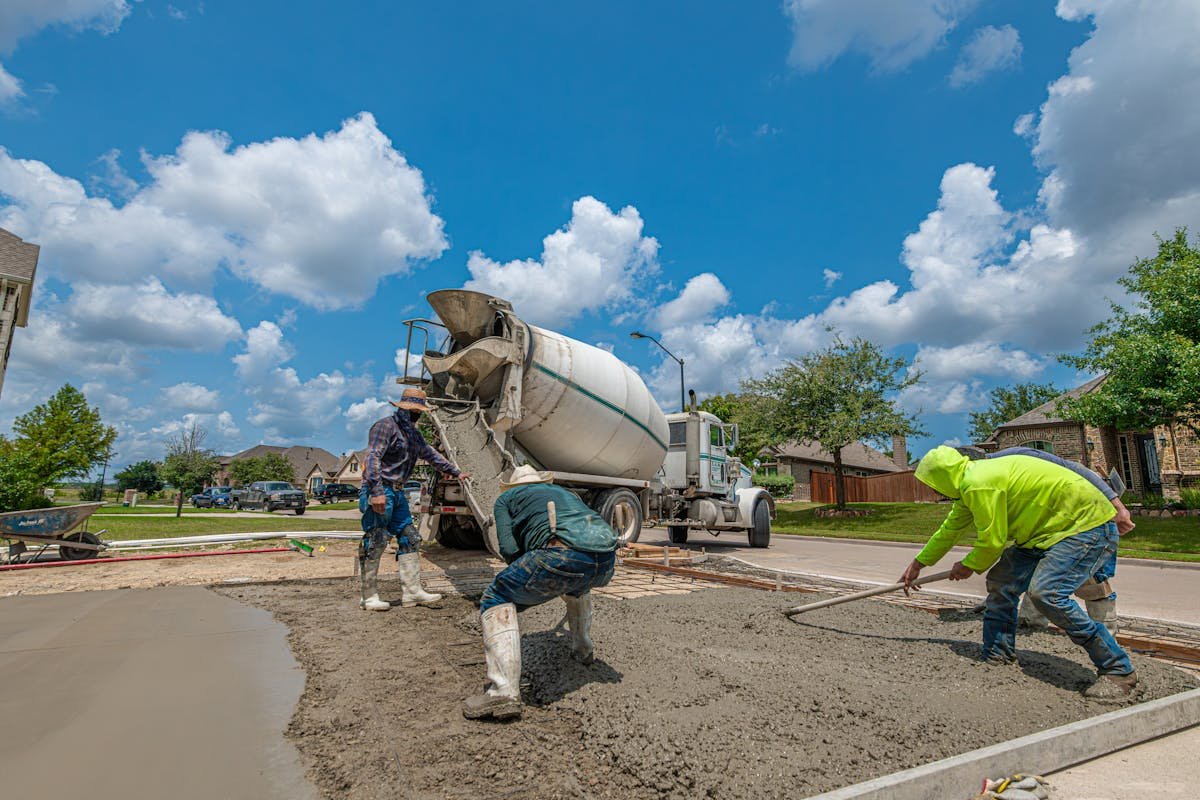
If you are choosing between a concrete driveway and a paver driveway for a Houston home, the answer depends on three things: how Texas clay soil is going to treat your investment, how much maintenance you actually want to do, and how much you care about the look of grout lines.
Quick comparison
For a standard Houston residential driveway, poured concrete typically wins on cost, maintenance, and longevity in clay soil. Pavers win when you want the look of individual stones, plan to access utilities under the driveway later, or want a heat island reduction with permeable joints. Most Greater Houston homeowners pick concrete.
Cost: installed pricing
| Concrete | Pavers | |
|---|---|---|
| Per sq ft installed | $5 - $12 | $15 - $30 |
| Two-car driveway (400 sq ft) | $2,600 - $3,600 | $7,000 - $12,000 |
| Lifecycle to 25 years | + light sealing every 3-5 yrs | + periodic re-sanding, weed control |
Houston clay soil
Greater Houston sits on expansive clay that swells and shrinks dramatically with seasonal moisture. This is the single biggest factor when choosing materials.
Concrete behaves as a single continuous slab on a reinforced base. When the soil moves, the slab moves as one piece. Hairline cracks at control joints are normal and expected, but the driveway stays flat.
Pavers are individual units sitting on a sand or gravel base. When the soil moves, individual pavers move — some settle, some heave, some rotate slightly. Within 5 to 10 years in untreated clay, paver driveways develop noticeable uneven sections that need to be lifted and re-set.
If you choose pavers in Houston, plan on having them re-leveled at year 5-7 and again at year 12-15. That work runs $2-4 per sq ft each time.
Maintenance reality check
Concrete maintenance is essentially: sweep occasionally, rinse with water, seal every 3-5 years if you want to (optional for broom finish, mandatory for stamped or stained). Total annual time investment: maybe 30 minutes per year.
Paver maintenance is: sweep, rinse, treat for weeds in the joints (especially mid-summer in Houston), pull weeds that beat the treatment, refill polymeric sand in the joints every 3-5 years, and address individual pavers that have settled. Realistic annual time: 4-8 hours.
The aesthetics question
Pavers have a refined, residential, almost European appearance. Walking from your front door to a paver driveway feels like a deliberate hardscape choice. There is no equivalent look from poured concrete unless you go to stamped work — and even premium stamped concrete reads as concrete that mimics pavers, not actual pavers.
If the look of individual stone units is a hard requirement for your home's curb appeal, pavers are the right answer despite the maintenance cost.
Stamped concrete: the in-between
Stamped concrete is poured concrete with texture mats pressed into the surface and color hardeners applied to create the appearance of pavers or stone. Pricing falls between the two: $12-22 per sq ft installed for stamped vs. $5-12 for standard concrete and $15-30 for actual pavers.
For Houston homeowners who want the look of pavers without the joint maintenance, stamped concrete is the right compromise. The look is good enough that the average passerby cannot tell the difference; the maintenance is just standard concrete care.
Utility access
If you have utilities running under your driveway (water main, gas, sewer cleanouts) and you anticipate possible future work, pavers have a real advantage: individual sections can be lifted, the utility work done, and the pavers reset. With concrete, the same access requires saw-cutting, removal, and a patch pour — the repair will be visible.
For homes built in the last 10 years with utilities in standard locations, this rarely matters. For older Houston homes with mystery infrastructure under the driveway, it can.
Permeability and drainage
Pavers can be installed with permeable joints that allow water to drain through, reducing runoff and heat. This matters more in commercial settings or HOAs with stormwater requirements. For residential properties, this is rarely a deciding factor in Houston.
HOA and architectural review
Some Houston HOAs (especially in West U, Bellaire, the Memorial Villages, and certain Woodlands sub-villages) have specific architectural requirements for driveways. Some require pavers or a stamped pattern in the visible apron section. Some prohibit decorative finishes. Check your HOA's architectural guidelines before deciding.
Bottom line
For most Greater Houston homeowners, the decision tree is:
- You want lowest installed cost and lowest maintenance: standard concrete driveway, broom finish.
- You want the look of pavers but the maintenance of concrete: stamped concrete, ashlar slate or random stone pattern.
- You want the genuine look of individual stone units and accept ongoing maintenance: pavers.
- Your HOA dictates the choice: follow the architectural guideline.
If you are still on the fence, get quotes for both and ask each contractor to specify the base preparation. Whichever you choose, the prep underneath is half the value.
Have a project in mind?
Free written estimate within 24 hours of the site visit. No deposit.
Get a free quote